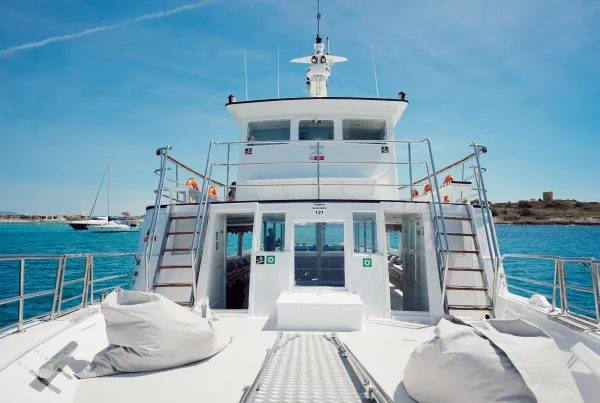
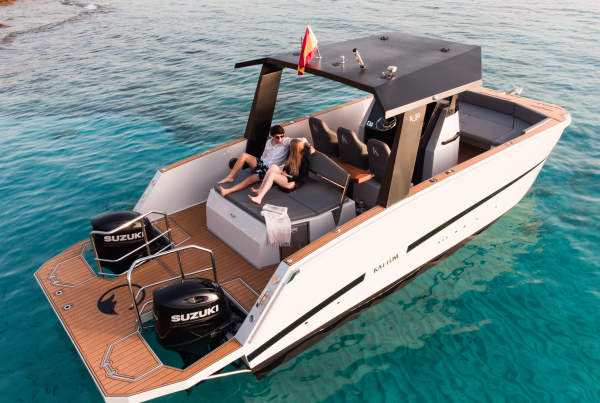
We're putting boats on the water for this one — open horizon, no traffic, and we can move if the clouds don't cooperate.
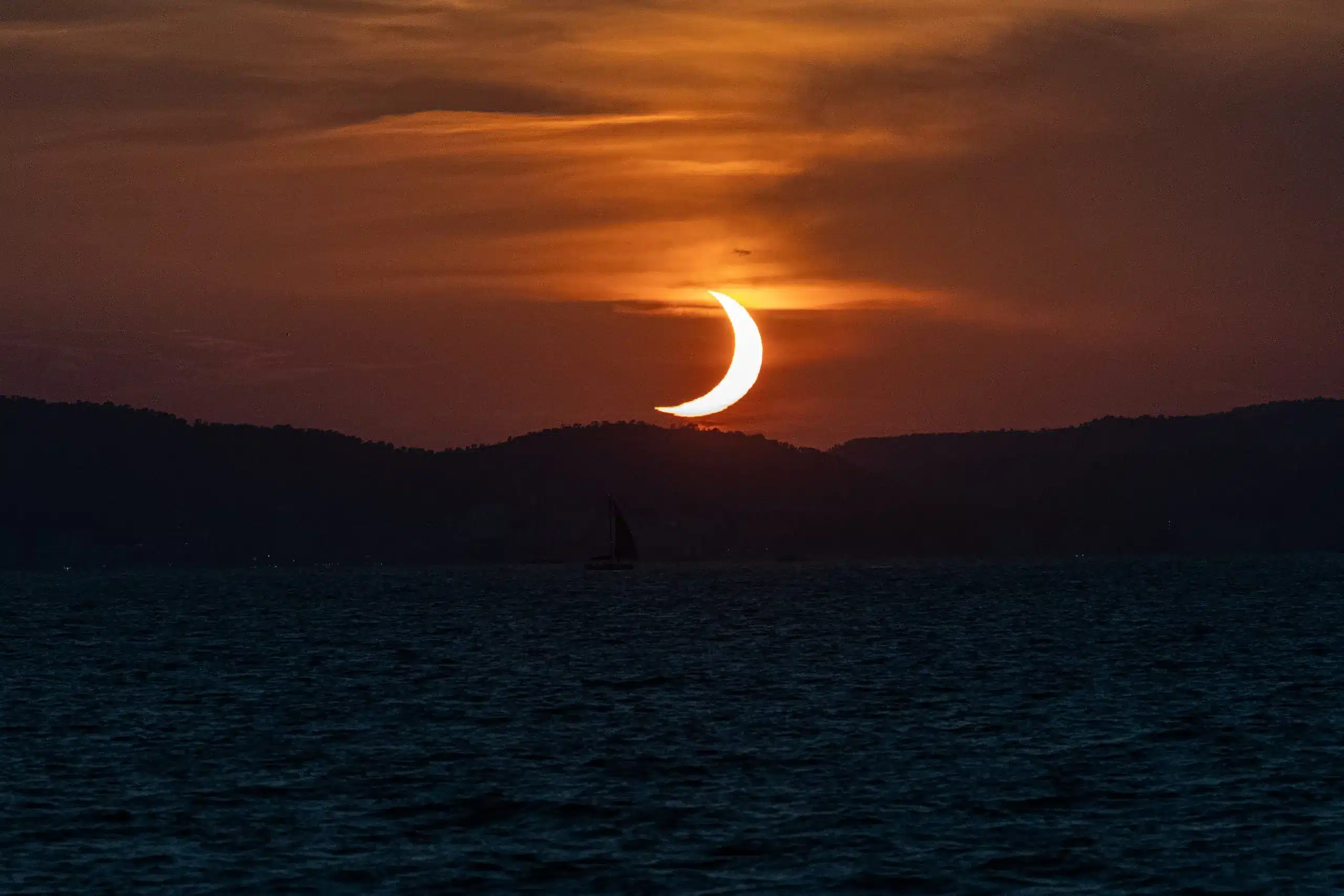
See more info about the eclipse Join the waitlistFrom Mallorca, the 2027 eclipse is a deep partial eclipse. At its maximum, the Moon covers just over 90% of the Sun’s diameter, around 89% of the visible disc. It is dramatic. It is not totality.
The band of totality, where the Sun disappears completely and the corona comes out, crosses the Strait of Gibraltar: Cádiz, Málaga, Ceuta and Melilla. From the Balearics you are roughly 700 kilometres north of it.
We say this plainly because a lot of coverage is blurring the line, and people who travelled for the total eclipse of August 2026 know the difference is not a technicality. A 90% partial and a total eclipse are two different experiences.
Exact times for Palma de Mallorca
All times are local (CEST) and accurate to within a few seconds.
| Phase | Time | Sun’s height | What happens |
|---|---|---|---|
| Partial eclipse begins | 09:49 | 33° | First contact — a small notch appears on the Sun’s edge |
| Maximum eclipse | 10:58 | 46° | The deepest point. The Sun becomes a thin crescent |
| Partial eclipse ends | 12:13 | 59° | Last contact — the Sun is whole again |
Total duration: 2 hours and 24 minutes.
The key number in that table is the middle one on the right: 46 degrees. That is how high the Sun sits at maximum, and it is the reason this eclipse is easier to watch than the last one.
In August 2026, totality arrived minutes before sunset with the Sun scraping the horizon. Beautiful, but it meant that a hill, a headland or a bank of haze in the wrong place could take the whole thing away from you. In 2027 the Sun will be nearly halfway up the sky at mid-morning. Far fewer ways for it to go wrong.
Will it go dark?
No, and this is the single most common misunderstanding.
With about 89% of the Sun covered you will notice a real change, but it stays daylight. What people report at this depth is that the light goes strangely flat and metallic, shadows turn unusually sharp-edged, the temperature drops a few degrees, and there is an odd quality to everything that is hard to describe until you’ve seen it. Birds sometimes go quiet.
But streetlights will not come on. You will not see stars. The Sun’s corona will not appear. That last 10% of the Sun is astonishingly bright, sunlight does not fade in proportion to how much of the disc is hidden.
One thing you must not get wrong
During a total eclipse there is a brief window, in totality only, when it is safe to look with the naked eye.
In a partial eclipse, that window never opens. Not for a second, at any point in the 2 hours and 24 minutes.
A sliver of uncovered Sun is more than enough to burn your retina permanently, and, this is the dangerous part, it does not hurt while it is happening. There are no pain receptors in the retina. People discover the damage hours later.
Sunglasses do not work. Stacked sunglasses do not work. Smoked glass, exposed film negatives, CDs and phone screens do not work. You need eclipse glasses certified to ISO 12312-2, or a projection method like a pinhole. If you still have glasses from August 2026, check them for scratches and pinholes against a bright lamp before trusting them.
What about clouds?
Reasonably good odds. Historically, 2 August has been cloudy in Mallorca around 23% of the time since 2000, so roughly a three-in-four chance of a clear view, which is about as favourable as European eclipse-watching gets.
The catch with any fixed viewpoint on land is that you are committed. If a cloud bank parks itself over your headland at 10:50, that is your morning gone.
Where to watch it from
You do not need to be anywhere special, a 46° Sun is visible from essentially anywhere with sky above you. But some places are better than others:
- Anywhere with an open southeastern view. At maximum the Sun sits at azimuth 107°, so you want the east-southeast clear of tall buildings.
- The coast, over the Serra de Tramuntana. The mountains are more likely to generate cloud in August than the coastline is.
- On the water. No obstructions in any direction, no scramble for a parking spot, and the changing light across open sea is the part people remember from 2026.
Whatever you choose, decide before the day. In August 2026 the coast roads and viewpoints were jammed solid hours in advance, and a lot of people watched the best part of it through a windscreen.
And then the really good one: 26 January 2028
Here is the part most people don’t know yet.
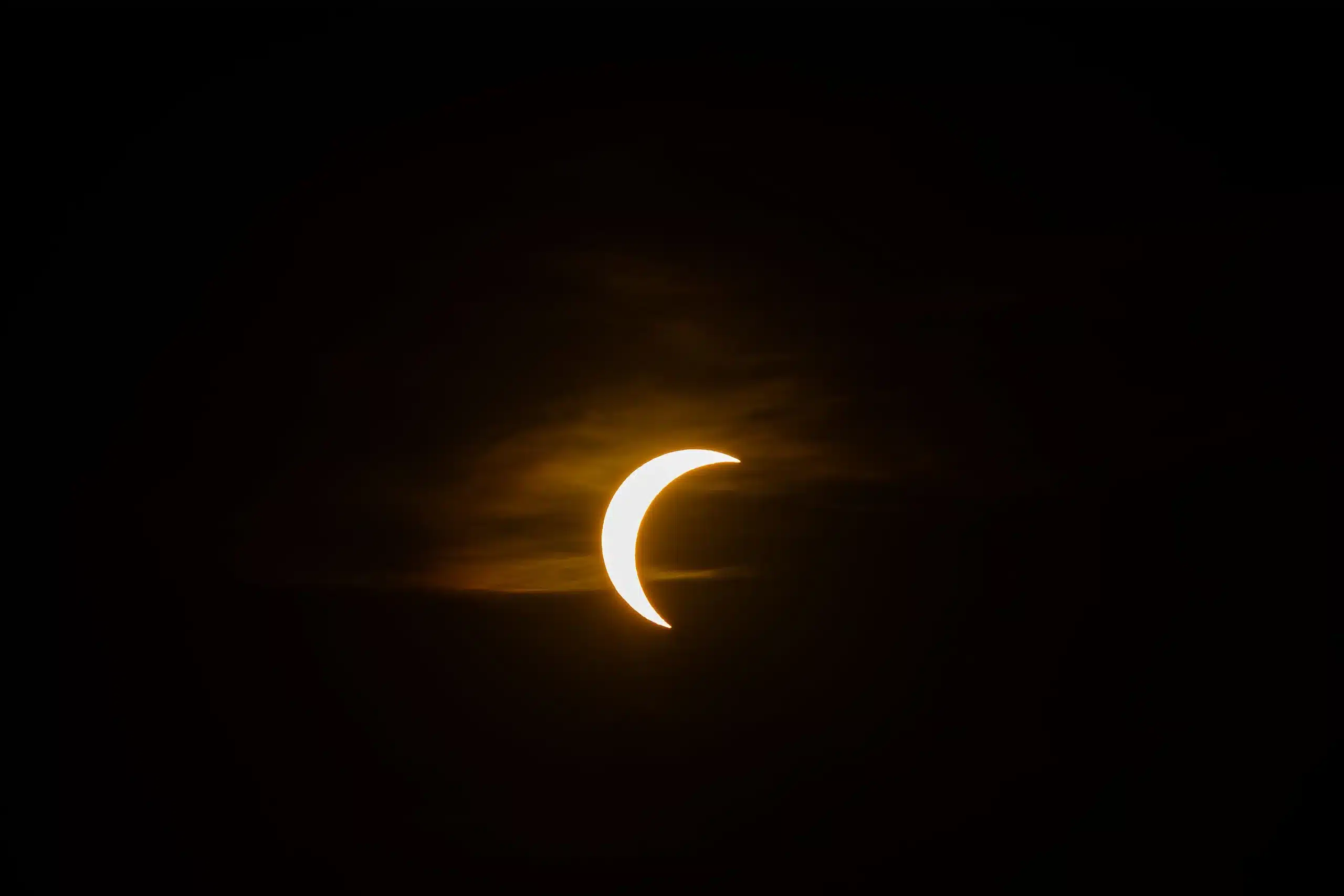
Mallorca is in the middle of what Spain’s Ministry of Science is calling the Trío de Eclipses — three major solar eclipses in under eighteen months. 2026 was the total. 2027 is this partial. And on 26 January 2028, the path of annularity crosses the Mediterranean and passes directly over Mallorca, Ibiza and Formentera.
An annular eclipse is when the Moon is slightly too far from Earth to cover the Sun completely, so a brilliant ring of sunlight remains around its edge, the “ring of fire”. And this one happens low over the sea at sunset, visible from Palma itself.
A golden ring hanging above the Mediterranean on a winter evening. For anyone who saw 2026 from the water, that one is worth putting in the calendar now.
In summary
- 2 August 2027, a Monday. Partial from Mallorca, 09:49 to 12:13, deepest at 10:58
- Just over 90% of the Sun’s diameter covered — impressive, but it stays daylight
- Certified ISO 12312-2 glasses required for every single second of it
- Totality is in Andalusia, not the Balearics — don’t let anyone tell you otherwise
- The real prize for Mallorca is the ring of fire on 26 January 2028
Sources: eclipse circumstances for Palma from timeanddate.com, cross-checked with Spain’s Instituto Geográfico Nacional and the Ministry of Science’s official Trío de Eclipses portal.
Watch the 2027 eclipse from the sea
Places will be limited and we sold out in 2026. Join the waitlist — no payment, no commitment, and you'll hear before we open general booking.
Join the waitlist See more info about the eclipse